
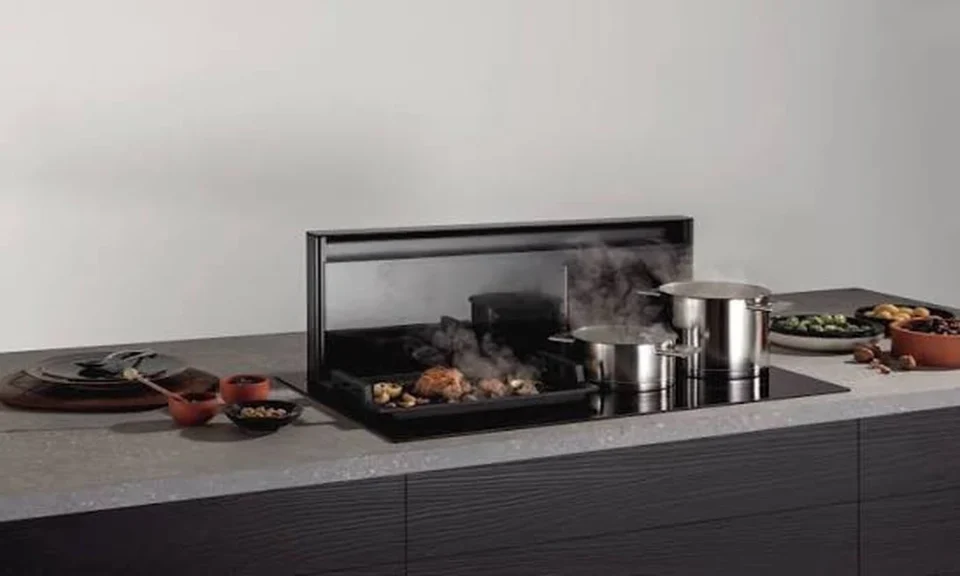
The extractor hob represents one of the most genuinely innovative product categories to emerge in kitchen design over the past decade. By integrating the cooking surface and the extraction system into a single unit, it eliminates the conventional overhead hood entirely – changing the visual and spatial character of the kitchen while delivering extraction performance that is, in well-designed examples, more effective than many traditional hood installations.
How Extractor Hobs Work
An [object Object] draws cooking vapours down from the cooking surface rather than up – through extraction grilles integrated into the hob surface, either between the cooking zones or around their perimeter. The captured air is then either ducted outside through floor-level or side-wall routes, or filtered and recirculated in ductless installations. The proximity of the extraction point to the vapour source – directly at the surface rather than 60 to 75cm above it – means the capture efficiency can be excellent even at relatively modest extraction rates.
Design Benefits
The most immediately apparent benefit of the extractor hob is what it removes from the kitchen: the overhead hood. In open-plan spaces, this dramatically changes the visual openness of the kitchen area. Island cooking positions – previously requiring ceiling-suspended island hoods – become possible without the overhead installation challenge. Kitchen designers gain flexibility in cabinet configuration, lighting design, and the overall aesthetic direction of the cooking area.
Practical Considerations
The integration that makes extractor hobs visually appealing also creates some practical considerations worth understanding before purchase. Ducting routes run through floor cabinets or walls rather than up through ceiling spaces – which works well in most kitchens but requires planning during renovation. The cooking zones and extraction zones are part of the same unit, which means a fault in either requires attention to the integrated system rather than a replaceable component. And the extraction motor, positioned below the cooking surface, operates in a warmer environment than overhead hoods. Products like [object Object] provide flexible portable extraction for spaces where integrated solutions are not yet installed.
Performance at the Source
For cooking that generates significant steam or grease – high-heat sautéing, deep frying, wok cooking – the proximity advantage of downdraft extraction is most pronounced. Vapours are captured before they have risen to the height where an overhead hood would encounter them, which reduces the energy required for equivalent extraction effectiveness. The trade-off is that very high vapour volumes – steam from large pasta pots, for example – can challenge downdraft systems more than an equivalent overhead installation, as the natural upward convection of hot steam works against the downward extraction direction.
