
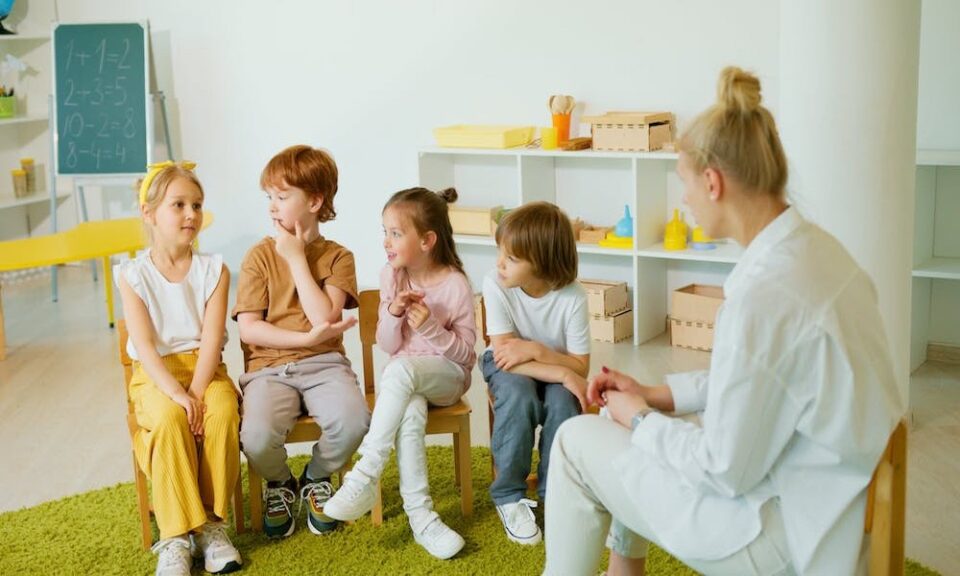
In many traditional schools, children are placed in classes based solely on their year of birth. The Montessori method organises its groups differently, focusing on developmental stages.
This creates a unique community where children from three to six years old learn together. The classroom becomes a dynamic social environment.
Younger pupils observe and imitate their older peers, who in turn reinforce their own knowledge by guiding others. This natural cycle drives learning and growth.
The approach is a deliberate pedagogical choice, not merely an organisational convenience. It is rooted in decades of observation about how young minds develop most effectively.
This structure supports comprehensive child development across social, emotional, and intellectual domains. It presents a compelling alternative to age-segregated models.
Key Takeaways
- Montessori classrooms group children by developmental stage, not chronological age alone.
- The three to six-year age range represents a critical period for acquiring foundational skills.
- Mixed-age environments naturally foster peer learning, mentorship, and collaboration.
- This educational structure differs significantly from traditional, single-year classrooms.
- It offers proven advantages for holistic development in young learners.
- The model is a deliberate pedagogical choice, supported by long-term practises in Montessori schools worldwide.
Introduction to the Mixed-Age Grouping Concept
The concept of mixing children of various ages in one learning space originates from careful scientific observation. This approach forms the bedrock of the Montessori approach to early education.
It mirrors the natural social structures found in families and communities throughout life.
The Rationale Behind Mixed-Age Classrooms
Dr. Maria Montessori argued that segregating by age is detrimental. She believed it breaks vital social bonds.
In her view, a vibrant community requires interaction between people of different ages. This way of organising a classroom fosters a cooperative “society by cohesion”.
Children learn to balance group needs with their own. Multi-age classrooms replicate this real-world dynamic perfectly.
Historical Foundations in Montessori Education
This model began with Dr. Montessori’s first school, the Casa dei Bambini, in Rome in 1907. She observed how older and younger children naturally helped each other.
“Our schools have shown how children of different ages help one another. The younger ones watch what the older ones are doing and ask all kinds of questions, and the older ones explain.”
Dr. Maria Montessori
She designed the primary classroom for children aged three to six years. This three-year cycle is a deliberate, time-tested structure.
Over a century of practice validates multi-age classrooms. They are not an experiment but a refined pedagogical norm.
|
Feature |
Traditional Model |
Montessori Model |
|
Grouping Basis |
Chronological age (single year) |
Developmental stage (3-year span) |
|
Social Structure |
Age-segregated peers |
Mixed-age community |
|
Learning Dynamic |
Teacher-led instruction |
Peer learning & mentorship |
|
Historical Precedent |
Industrial-era standardisation |
Originated 1907 (Casa dei Bambini) |
Social and Emotional Growth in a Diverse Classroom
A diverse classroom of three to six-year-olds provides a fertile ground for cultivating empathy and responsibility. This environment nurtures essential social skills through daily, meaningful interactions.
Peer Learning and Role Modelling
Older pupils naturally demonstrate activities to younger children. This creates an accessible teaching dynamic.
By guiding others, they solidify their own knowledge and develop leadership abilities. Younger ones gain relatable role models for the skills they will soon master.
Fostering Empathy and Independence
Older children recognise the struggles their younger peers face. They remember their own recent experiences and respond with patience.
They learn to judge when help is truly needed. Dr. Montessori observed this respectful balance, noting children “respect one another’s efforts and give help only when it is necessary”.
This builds emotional intelligence and independence. Children feel secure yet challenged within their supportive community.
|
Social-Emotional Skill |
Mixed-Age Environment |
Single-Age Setting |
|
Leadership Development |
Ongoing, through natural mentorship |
Limited, teacher-assigned roles |
|
Empathy Building |
Daily, from caring for younger peers |
Less frequent, among equals |
|
Independence |
Fostered through respectful non-interference |
Often teacher-directed |
|
Peer Relationships |
Complex, cross-age bonds of affection |
Primarily horizontal, same-age |
Benefits of Mixed-Age Grouping in Montessori Education for 3-6 Year Olds
Beyond social harmony, the mixed-age classroom acts as a powerful engine for cognitive development. Research substantiates this, showing profound advantages for young minds.
Studies by Stone (1998) and Veenman (1996) found children in these settings develop more affirmative attitudes about themselves. They also gain a realistic understanding of social interactions, preparing them for life beyond the classroom.
Enhancing Intellectual and Social Abilities
Younger students learn extensively through observation. Watching older children work with advanced materials sparks curiosity and allows them to absorb concepts early.
This natural motivation replaces forced compliance. Children are inspired to try new activities after seeing their peers succeed.
Older pupils, in turn, deepen their own understanding by explaining concepts. Teaching reinforces their mastery and builds confidence as capable mentors.
The environment supports an individualised pace. There is no pressure to keep up with a lockstep curriculum. Eilmar Montessori implements this model to ensure each child’s growth is personal and continuous.
Competition dissolves as students focus on their own interests. Over a three-year cycle, each child has the opportunity to experience different roles, building a complete set of skills and experiences.
The Role of Experienced Teachers and Unique Learning Environments
Managing a classroom spanning three developmental years demands a unique set of teaching qualifications. This requirement places Montessori schools in a specialised category of education, where the supply of adept teachers is limited.
These educators must facilitate an environment that promotes collaboration across a wide range of ages and abilities.
Expert Guidance from Eilmar Montessori
Specialised training is essential. It equips teachers to handle the complex dynamics of mixed-age classrooms.
They learn to provide individualised attention while maintaining group cohesion. A Montessori approach is flexible, relying on observation rather than a rigid curriculum.
This way of working allows a teacher to tailor lessons to meet both individual and collective needs. Eilmar Montessori recognises the importance of such highly qualified educators.
Collaborative Support from Eilmar
Ongoing professional guidance helps teachers master this delicate balance. They develop strategies for facilitating peer teaching and creating harmonious communities.
When students stay with the same teacher for multiple years, a deep bond forms. The educator gains profound knowledge of each child’s learning style and motivators.
This continuity benefits parents through more meaningful communication. Eilmar provides resources to help teachers prepare the environment with materials suitable for all ages.
Younger students and their older peers can then explore side-by-side. Effective instruction in this setting depends on understanding child development across the 3-6 age span.
Conclusion
Ultimately, this educational model cultivates essential human qualities from the earliest years. It recognises how young people learn most effectively through natural social interactions.
The multi-age classrooms structure is a fundamental element of Montessori philosophy. It supports comprehensive child development across social, emotional, and intellectual domains.
Children who develop empathy, independence, and leadership in these settings carry these qualities throughout life. Parents gain confidence knowing this approach is validated by over a century of practice.
These experiences contribute to broader social goals. Pupils learn to live peacefully in diverse groups, preparing them to create harmonious communities as adults.
Specially trained teachers play an essential role. They observe and guide each child’s individual pace within the collaborative environment.
The relationships and self-confidence built here provide a strong foundation for future academic success. This makes the approach a valuable investment in a child’s educational journey.
FAQ
How does a mixed-age classroom actually function on a daily basis?
In a multi-age setting, children engage in a cycle of learning that mirrors real life. Younger students observe and learn from the activities of their older peers, who in turn reinforce their own knowledge by demonstrating skills. The teacher presents lessons to individuals or small groups based on readiness, not chronological age, allowing each child to progress at their own pace within a collaborative environment.
What are the key social advantages for my child in this type of setting?
This approach nurtures essential life skills. Younger children gain confidence and learn through observation, while older ones develop leadership, patience, and empathy by helping others. It creates a natural, family-like community where children build strong, supportive relationships with peers of different abilities, reducing competitive pressure and fostering a genuine sense of belonging.
Won’t my younger child fall behind or my older child be held back?
The Montessori method is designed to prevent this. The curriculum is individualised, so a child is always working with materials that match their developmental stage and interests. An older child mastering complex concepts is never waiting for a younger peer to catch up. Conversely, a younger child is free to explore foundational skills without feeling rushed, supported by the rich environment and their older classmates.
How do teachers manage such a diverse range of ages and abilities?
Experienced Montessori educators, such as those at Eilmar Montessori, are specially trained to observe and guide each child individually. They act as facilitators, carefully preparing the classroom environment with materials that cater to a three-year developmental span. Their expertise allows them to connect each student with appropriate challenges and leverage the natural dynamics of the multi-age group to enhance learning for everyone.
Is this approach only beneficial for academic learning?
No, its benefits are profoundly holistic. While intellectual growth is nurtured through peer teaching and self-paced discovery, the primary gains are often in social and emotional development. Children naturally learn conflict resolution, communication, and cooperation. They develop a strong sense of responsibility and independence, skills that are crucial for success in school and all future endeavours.
